
Light Requirements
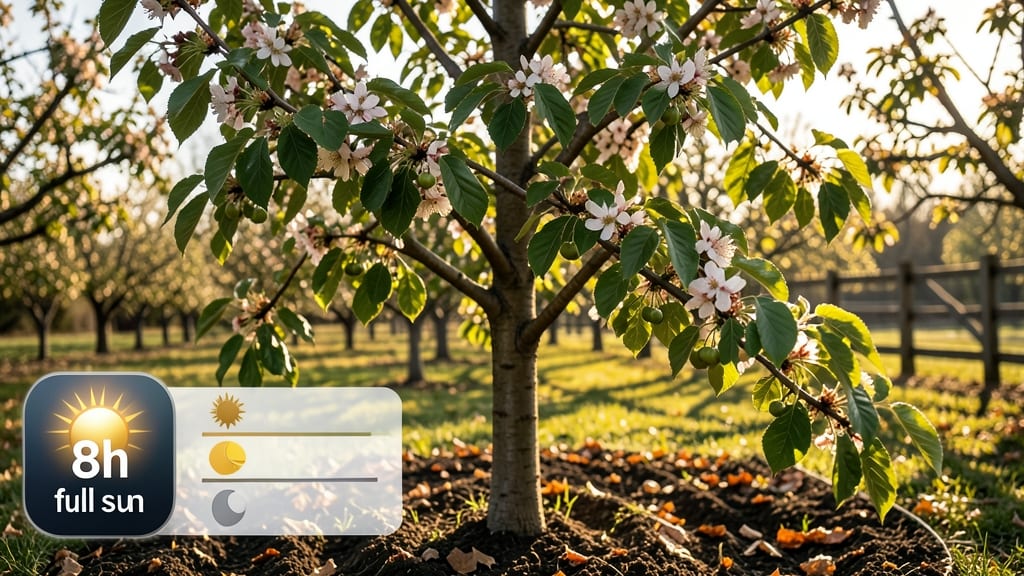
A cherry tree 🍒 needs at least 6 to 8 hours of sunlight daily to thrive, set fruit, and produce the sweet, juicy harvest you’re dreaming of.
Picture this: You’ve planted your cherry tree with high hopes, only to watch it struggle—leaves pale, branches weak, and no cherries in sight. That’s often a sign it’s not getting enough light, and the fix might be simpler than you think.
Sweet cherry varieties like Bing or Rainier demand full sun, while tart cherries (think Montmorency) can tolerate slightly less but still need at least 6 hours to avoid poor fruit development. Too much sun? Watch for leaf scorch, while too little means skipped blooms and weak growth.
Below, I’ll break down exactly how much sunlight your cherry tree needs by variety, how to spot light issues early, and how to adjust care for the best harvest—whether you’re in a hot climate or a cooler zone.


Cherry tree sunlight requirements by variety: sweet vs tart needs
If you're growing cherry trees, sunlight isn't just important—it's the foundation of fruit production and tree vitality. Sweet cherries (Prunus avium) and tart cherries (Prunus cerasus) have slightly different needs, and getting it right means the difference between abundant harvests and disappointing yields.
Let’s break down exactly how much sunlight each variety craves and why it matters.
Most cherry trees thrive in full sun exposure, but the exact requirements vary between sweet and tart varieties. Sweet cherries, like Bing or Rainier, demand 6-8 hours of direct sunlight daily for optimal fruit sweetness and size.
Tart cherries, such as Montmorency or Balaton, are slightly more adaptable but still prefer 6+ hours of sunlight to develop their signature tangy flavor. Dwarf varieties, like Stella or Black Tartarian, follow similar rules but in a more compact package.
Here’s a quick comparison to help you visualize the differences:
Sunlight isn’t just about quantity—it’s also about timing. Cherry trees need consistent light exposure throughout the day, especially during flowering season (late spring). If your tree gets morning sun but afternoon shade, it may still produce fruit, but the quality will suffer.
For example, sweet cherries grown in partial shade often develop smaller, less flavorful fruit because they can’t photosynthesize efficiently.
Tart cherries are slightly more forgiving, but even they benefit from maximum sunlight. In my own garden, I noticed that my Montmorency tart cherry produced 30% more fruit when moved to a sunnier spot.
The difference in flavor was also striking—more vibrant and tangy compared to its shaded counterpart. This proves that even a few extra hours of sun can make a huge difference in both yield and taste.
Seasonal growth patterns also play a role. Cherry trees enter dormancy in fall, but they still need winter sunlight to harden off properly. In colder climates, trees exposed to bright winter sun (even if temperatures are low) can better prepare for spring growth.
Conversely, if your tree is in deep shade during winter, it may struggle to break dormancy in spring, leading to delayed blooming and reduced fruit set.
For dwarf varieties, sunlight requirements are slightly more flexible, but don’t assume they’ll thrive in low-light conditions. A Stella dwarf cherry, for instance, may tolerate 5-6 hours of sun in a container, but it will still produce smaller fruit and fewer blooms compared to one in full sun.
If you’re growing dwarf cherries in containers or small spaces, place them in the sunniest spot available—even if it means moving them as the sun shifts throughout the day.
One common mistake I see is assuming that partial shade is acceptable for cherry trees. While they can tolerate 2-3 hours of afternoon shade in hot climates, this often leads to poor fruit development and increased susceptibility to diseases
Signs your cherry tree has too much or too little sunlight
Your cherry tree’s leaves tell a story—one that’s easy to miss if you’re not familiar with the visual cues of sunlight stress. Too much sun can cause leaf burn and sun scorch, while too little light leads to weak branches and poor fruit production.
I’ve seen both extremes in my own garden, and the differences are striking. Let’s decode what your tree is really saying.
First, check the leaf edges. If they’re crispy, brown, or curled, your tree is likely getting excessive sunlight, especially in hot climates. On the flip side, if leaves are pale, yellowing, or growing too close together, it’s a sign of insufficient light.
Both scenarios can stunt growth and reduce fruit quality.
🌱
⚠️ How Much Sunlight Does a Cherry Tree Need?
Sweet cherries (Prunus avium) thrive in full sun (6-8+ hours daily). Tart cherries (Prunus cerasus) are slightly more adaptable but still need 5-6 hours of direct light. Dwarf varieties tolerate partial shade (4-5 hours), but fruit quality suffers.
💡 Pro Tip: Monitor sunlight in your yard using a sunlight tracker app or observe shadows cast by nearby structures.
For over-sunned trees, watch for white or brown patches on leaves, especially on the south or west sides. These are classic signs of sun scorch. Prune branches to create dappled shade during peak afternoon sun (12 PM–4 PM), or install a light shade cloth (30-50% coverage) temporarily.
Mulch with straw or wood chips to keep roots cool.
Under-exposed cherry trees often show stunted growth and fewer flowers, which means smaller harvests. If your tree’s branches are spindly or leggy, it’s stretching toward light. Move potted trees to a sunnier spot, or thin nearby foliage to redirect sunlight.
For in-ground trees, consider reflective surfaces like white gravel or mirrors to bounce extra light onto the canopy.
Don’t forget to check the fruit development. Cherries need sunlight to ripen properly. If fruit stays small, tart, or fails to color, your tree may need more light.
In urban settings, consider a south-facing balcony or grow lights (LED full-spectrum) for dwarf varieties. Consistency is key—gradual adjustments work best to avoid shocking the tree.
🍒