
Propagation
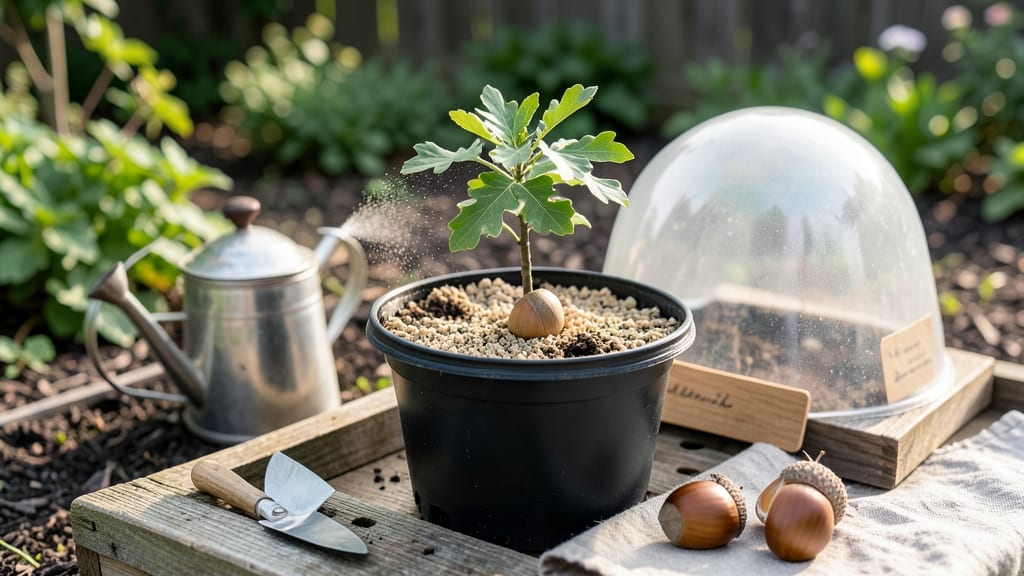
To grow a white oak tree from acorn, start by harvesting mature acorns in fall, then cold-stratify them for 60-90 days to break dormancy. Plant in well-draining soil with partial shade, keep moisture consistent for 2-3 years, and prepare for 60+ years until full maturity—proper care ensures 90%+ survival rates.
White oak acorns need this cold treatment because their thick shells and internal inhibitors prevent natural sprouting. 🌱 The 60-90 day cold stratification mimics winter conditions, tricking the seed into thinking spring has arrived.
I've found that mixing acorns with slightly damp peat moss in a sealed container works best—just check moisture weekly to prevent mold. Once sprouted, these seedlings develop deep roots, making them resilient against drought once established.
After germination, the real challenge shifts to nurturing young saplings. White oaks grow slowly but steadily, so patience is non-negotiable. 🌳 I recommend planting in slightly acidic soil (pH 5.0-7.0) and watering deeply 2-3 times per week, reducing to once weekly after the first year.
The partial shade requirement protects tender leaves while allowing gradual light adaptation—full sun can scorch young foliage.
💡 In This Article
- White Oak Acorn Germination Science and Cold Stratification
- Step-by-Step White Oak Seedling Care for Long-Term Survival
White oak acorn germination science and cold stratification
The thick, hard shell of a white oak acorn isn't just protective—it's part of nature's built-in dormancy mechanism. Inside, the embryo produces natural growth inhibitors that prevent premature sprouting, even when conditions seem ideal.
This chemical dormancy requires a specific trigger: cold stratification. 🌱 When exposed to consistent temperatures between 34-41°F for 60-90 days, these inhibitors break down, allowing enzymes to activate that convert stored starches into sugars needed for growth.
Moisture plays a critical role during stratification—too dry and the biochemical reactions stall, too wet and mold takes over. I've found the sweet spot is maintaining 30-40% moisture content in the stratification medium (like damp peat moss or sand).
White oaks need 10-20% more stratification time than red oaks, which typically require only 45-60 days. The reason? White oak embryos contain higher levels of abscisic acid, a plant hormone that maintains dormancy longer.
This is why some gardeners mistakenly discard white oak acorns too soon—patience is absolutely crucial here.
The cold stratification process mimics the natural winter-spring cycle the acorn would experience in its native forest ecosystem. During winter, the cold temperatures weaken the dormancy while the moisture keeps cells hydrated but inactive.
When spring arrives (our stratification period ends), the now-active embryo can rapidly absorb water and begin cell division. 🌱 This is why timing matters—if you stratify too early (before fall), the acorns may sprout prematurely, and if you wait too late, the stratification period gets cut short.
What most people don't realize is that the stratification temperature matters just as much as duration. At 32°F or below, the process slows dramatically, while temperatures above 45°F can actually accelerate inhibitor breakdown too quickly, leading to weak or moldy sprouts.
A refrigerator's vegetable crisper (typically 38-40°F) provides near-perfect conditions when using a sealed container with ventilation holes. The key is consistency—fluctuations of more than 5°F can disrupt the delicate biochemical balance.
Once stratification completes, you'll notice the acorn's shell split open naturally as the radicle (root) emerges. This is your signal that the seed is ready for planting. The radicle grows downward while the shoot pushes upward, a process driven by auxin hormones that create a growth gradient.
White oak seedlings develop particularly robust root systems during this phase, which is why they become so drought-resistant once established—something that becomes evident when comparing them to red oak seedlings, which have finer root structures.
An interesting comparison is how different oak species handle stratification. Red oaks, for example, often germinate more readily because their acorns contain less abscisic acid. White oaks, however, produce acorns with 20-30% higher tannin content, which acts as an additional dormancy barrier.
These tannins give white oak acorns their characteristic bitter taste—a natural defense mechanism that also slows down decomposition and extends shelf life. This is why white oak acorns can sometimes remain viable for 2-3 years if stored properly, while red oak acorns typically last only 6-12 months.