
Lawn
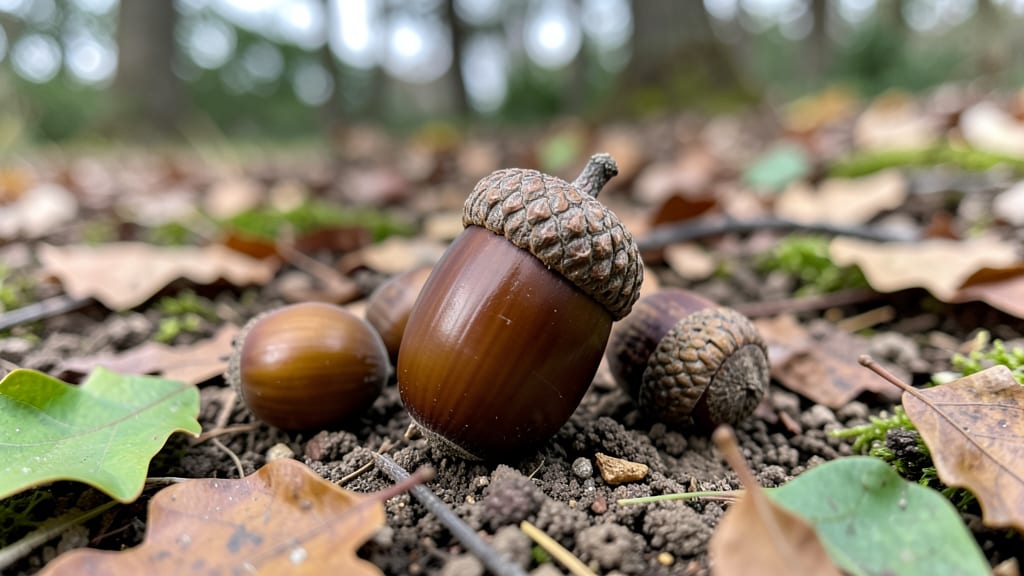
An oak tree seed looks like a small, oval-shaped acorn with a glossy brown cap (cupule) and a nut inside, ranging from pea-sized to over an inch long depending on the oak species. The cap often has scales or fringes, while the nut itself is smooth or slightly textured.
Oak tree seeds—commonly called acorns—are instantly recognizable by their distinctive cup-shaped cap that encases the nut. 🌳 Unlike other nuts, acorns have a unique oval or elongated shape, with the cap often featuring spiky edges or overlapping scales.
White oak acorns, for example, tend to have a smoother, more rounded cap compared to the flatter, more pronounced caps of red oak acorns. The size alone can tell you a lot: larger acorns typically come from mature trees and are more likely to germinate successfully.
What makes acorns so fascinating is how their appearance changes as they mature. Fresh acorns have a vibrant brown or reddish hue, but as they dry out, they darken and often develop a glossy sheen.
The cap’s texture—whether fuzzy, scaly, or smooth—can also help identify the oak species, making them a naturalist’s treasure. If you’ve ever collected acorns in the fall, you know how their weight and size can vary dramatically from one tree to another!
💡 In This Article
- Identifying Acorn Shapes and Sizes by Oak Species
- How to Tell Mature Acorns Ready for Planting
Identifying acorn shapes and sizes by oak species
Acorn morphology varies dramatically between oak species, with the most noticeable differences appearing in the capule (cup) structure and nut size. White oak acorns, like those from the Quercus alba species, typically have a smoother, more rounded cap with a shallow cup shape.
Their nuts are usually 1-1.5 inches long and have a flat base, often appearing slightly elongated.
In contrast, red oak acorns (e.g., Quercus rubra) feature a flatter, more pronounced cap with noticeable fringes or scales, and their nuts tend to be shorter but wider, around 0.75-1 inch in length.
The texture and color of the capule also serve as key identifiers. White oak capules are often glossy and dark brown, while red oak capules may appear lighter, almost tan, with a slightly fuzzy or scaly texture.
For example, the live oak (Quercus virginiana) produces acorns with a long, slender nut (up to 2 inches) and a deep, elongated cupule that can cover nearly half the nut’s length.
These variations aren’t just cosmetic—they reflect evolutionary adaptations to different environments and animal dispersers, like squirrels or jays, which rely on these features to recognize edible seeds. 🌿
Size alone can hint at the oak’s maturity and even its ecological role. Larger acorns, like those from bur oaks (Quercus macrocarpa), can reach 1.5-2 inches and have a prominent fringe around the capule, designed to deter squirrels from eating them whole.
Smaller acorns, such as those from pin oaks (Quercus palustris), are typically 0.5-0.75 inches long with a tight-fitting capule and a pointed tip. These differences matter for gardeners and foresters, as species-specific acorns have varying germination rates and growth habits.
Another critical detail is the nut’s base shape. White oak acorns have a flat, almost saucer-like base, while red oak acorns often feature a rounded or slightly indented base. This distinction is useful for identifying hybrid oaks or distinguishing between species in mixed forests.
For instance, the black oak (Quercus velutina) produces acorns with a deeply grooved capule and a nut that tapers to a sharp point, making them easily recognizable among other red oaks.
If you’re trying to identify an acorn in the wild, start by examining the capule’s depth and texture. A shallow, smooth capule suggests a white oak, while a deep, scaly capule points to a red oak.
Measuring the nut’s length and width with a ruler can also help narrow down the species. For example, chestnut oaks (Quercus montana) have acorns that are 1-1.5 inches long with a capule that covers only the top third, distinguishing them from other species with more enclosed nuts.
For a hands-on approach, collect acorns from different oak trees in your area and compare their features side by side. Notice how the capule’s attachment point varies—some acorns have a tight fit, while others allow the nut to wiggle slightly.
This variation affects how easily the acorn detaches, a clue to its readiness for planting. 🌱 Understanding these nuances can turn a simple walk in the woods into a fascinating study of oak tree diversity.