
Plants
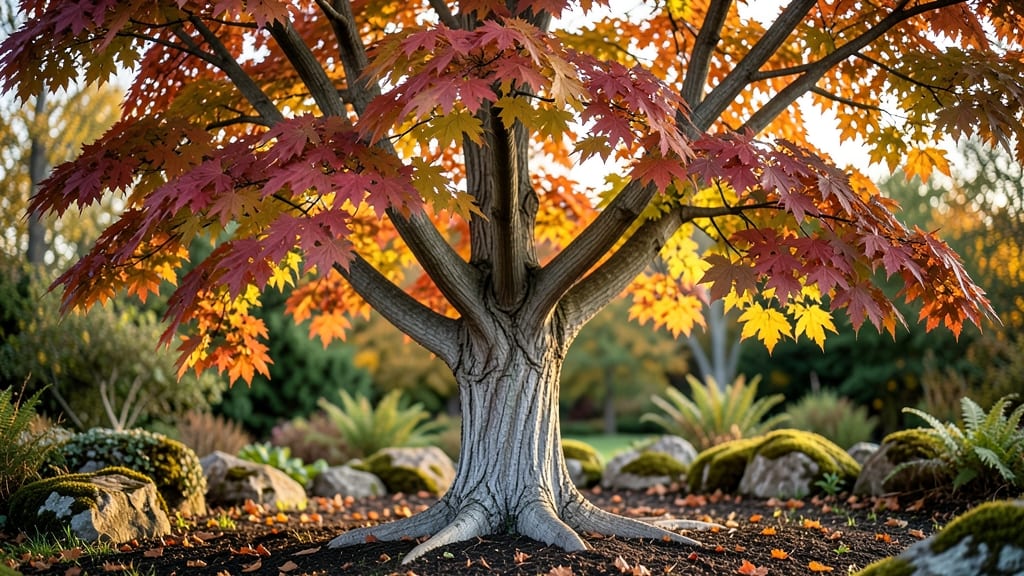
A maple tree looks like a tall, broad-crowned deciduous tree with distinctive palmate leaves featuring 3-9 pointed lobes, smooth gray bark that develops shallow furrows with age, and brilliant red, orange, or yellow fall foliage. Its samaras (helicopter seeds) are iconic.
A maple tree's most recognizable feature is its fan-shaped leaves, which spread out like open hands from a central point. 🌿 These leaves typically have 5-9 sharp points, though some varieties like the Norway maple can have up to 11.
The bark starts smooth and silvery-gray in younger trees but develops deeper grooves as the tree matures, creating a textured, almost sculptural appearance. What really sets maples apart is their spectacular autumn display—colors range from fiery reds to golden yellows, depending on the species and environmental conditions.
The iconic winged seeds (samaras) are another dead giveaway, spinning through the air like tiny helicopters. These seeds grow in pairs and are a key identifier when leaves have already fallen.
Different maple species also show unique growth habits: sugar maples tend to have a more rounded crown, while silver maples develop a vase-like shape with drooping branches. Understanding these visual cues makes it easier to spot maples even in winter when they're bare.
💡 In This Article
- Maple Tree Leaf, Bark, and Seed Identification Guide
- Seasonal Appearance Changes in Maple Trees
Maple tree leaf, bark, and seed identification guide
The most striking feature of maple leaves is their distinctive palmate shape, where 3-9 sharp, pointed lobes radiate from a single point like fingers on a hand. Sugar maples typically have 5 lobes with deep sinuses between them, creating a classic "V" shape at each point.
Red maples, however, often display 3-5 lobes with shallower sinuses, while silver maples have 5-7 lobes that are more rounded and less sharply pointed. The leaf edges range from serrated to smooth, with silver maples often showing a silvery underside due to fine hairs.
Bark texture varies dramatically by species and age. Young maples have smooth, silvery-gray bark that resembles elephant skin, but as they mature, the bark develops distinctive patterns. Sugar maples develop shallow, interlocking ridges forming a diamond pattern, while red maples show deeper, more pronounced furrows that create a scaly texture.
Silver maples have the most dramatic bark transformation, developing thick, corky ridges that can split and peel dramatically. These bark variations become especially noticeable in winter when leaves are absent.
The iconic samara seeds are another key identifier, with each seed consisting of two wings connected at a 180-degree angle. These helicopter-like seeds spin as they fall, allowing them to travel up to 120 feet from the parent tree.
Sugar maple samaras are typically 1-1.5 inches long with a slight curve, while red maple samaras are slightly smaller and more symmetrical. These seeds appear in late spring, often before the leaves fully emerge, creating a striking contrast against the fresh green foliage.
To distinguish maples from other trees, look for these combinations: palmate leaves with opposite branching (leaves grow directly across from each other on the stem), combined with the distinctive bark patterns.
For example, while oak leaves are lobed, they have a pinnate (feather-like) arrangement rather than the palmate shape of maples. The samaras are particularly helpful in late winter when other trees are still bare, as they often remain attached to branches until spring.
One common point of confusion is between maples and ash trees, which also have compound leaves. However, ash leaves are pinnately compound (multiple leaflets along a central stem), while maples have a single leaf with multiple lobes.
This fundamental difference in leaf structure makes identification straightforward once you know what to look for.
Consider these key visual cues when identifying maples:
- Leaf arrangement: Opposite branching (leaves directly across from each other)
- Leaf shape: Palmate with 3-9 lobes (never pinnate compound)
- Bark texture: Develops distinctive ridges or diamond patterns with age
- Seeds: Winged samaras that spin like helicopters
- Seasonal color: Vibrant autumn foliage (red, orange, or yellow)