
Size
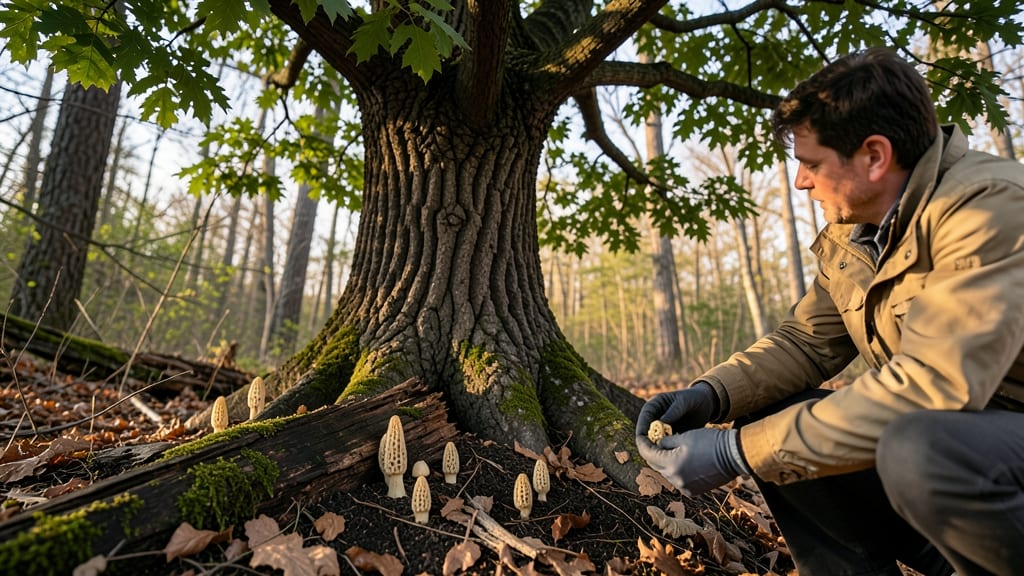
Morel mushrooms grow by specific trees like ash, apple, elm, and oak, often appearing near dead or dying wood in early spring. They thrive in moist, well-drained soil under these host trees, forming mycorrhizal relationships with their roots.
Morels have a fascinating partnership with certain trees, particularly those in decline. 🌳 These fungi rely on the organic matter from decaying wood and the nutrients released as trees break down, creating the perfect microclimate for their growth.
The most productive spots are often near old stumps, burn scars, or areas where trees have recently died—these "wounded" trees become hotspots for morel hunters.
What's interesting is that while ash, apple, and oak are classic hosts, regional variations exist: in some areas, you might find morels near hickory or even tulip poplar instead.
Understanding this relationship helps explain why morels appear so suddenly—often within days of a hard rain in spring.
The moisture triggers spore germination, but the real key is the tree's decay process. 🌱 Foragers who know these patterns can predict where morels will pop up, especially in areas with mixed hardwood forests.
Always check for these telltale signs when hunting: moist soil, decaying wood, and the right host tree species.
💡 In This Article
- Morel Mushroom Host Trees: Science Behind Their Symbiotic Relationships
- Best Trees for Morel Hunting: Foraging Tips and Tree Identification
Morel mushroom host trees: science behind their symbiotic relationships
Morels form a specialized type of mycorrhizal relationship with their host trees, but unlike typical mycorrhizae that exchange nutrients between living roots, morels often colonize decaying wood and dead trees.
The key lies in their ability to break down complex organic compounds through enzymes like cellulase and ligninase, which living trees can't process.
This decomposition releases nutrients that both the morel and surrounding ecosystem can utilize. 🌱 The most common hosts—ash, apple, elm, and oak—share one critical trait: they produce heartwood that resists decay initially but eventually breaks down, creating the ideal nutrient-rich substrate for morel spores.
Soil conditions play a surprisingly precise role in this partnership. Morels prefer well-drained soil with a pH between 6.0 and 7.5, though they can tolerate slightly acidic conditions (5.5-6.0) in regions with granite bedrock.
The moisture level must stay consistently high but not waterlogged—think of a damp sponge rather than a swamp. This balance explains why morels often appear after 1-2 inches of rain following a dry spell: the sudden moisture triggers spore germination in the pre-existing mycelial network beneath the soil.
Interestingly, morels rarely fruit in sandy soils because the nutrients leach away too quickly.
The decay process of the host tree is what actually kickstarts morel growth. When a tree dies, its heartwood begins to rot, creating microenvironments with temperatures between 50°F and 70°F—perfect for morel mycelium.
These fungi can detect the chemical changes in decaying wood, particularly the increase in simple sugars and amino acids released during the breakdown. 🌿 What's fascinating is that morels often appear near burn scars or storm-damaged trees because these injuries accelerate the decay process, creating a sudden nutrient flush that the fungi capitalize on.
This explains why experienced foragers often find morels in areas with a history of forest fires or lightning strikes.
Not all trees are equal when it comes to morel production. Ash trees, for example, are particularly prized because their wood contains high levels of nitrogen compounds that morels can readily metabolize.
Apple trees, meanwhile, provide both the decaying wood and the shallow root systems that create the perfect moisture gradient. Oak trees, while common hosts, often produce morels in larger clusters because their extensive root systems create more microhabitats.
The exception is coniferous trees like pine or spruce—morels almost never grow near them because these trees produce acidic soils and tannin-rich wood that inhibit fungal growth.
One of the most counterintuitive aspects of this relationship is that morels often appear after the host tree has died, sometimes even years later. This delayed fruiting strategy ensures the fungi have access to a stable food source when environmental conditions are optimal.
The mycelial network can remain dormant for years in the soil, waiting for the right combination of moisture, temperature, and decaying wood to trigger fruiting. 🔍 This is why experienced foragers often return to the same spots year after year—the mycelium is already there, just biding its time until conditions are perfect.
Understanding these ecological nuances can dramatically improve your foraging success. For instance, if you're searching near an ash tree, look for morels within 3-5 feet of the trunk where the soil is richest in decaying organic matter.
In apple orchards, focus on areas with old stumps or where trees have been recently pruned. The key is to think like a morel: it's not just about which tree you're near, but what's happening beneath the soil and within the decaying wood itself.