
Size
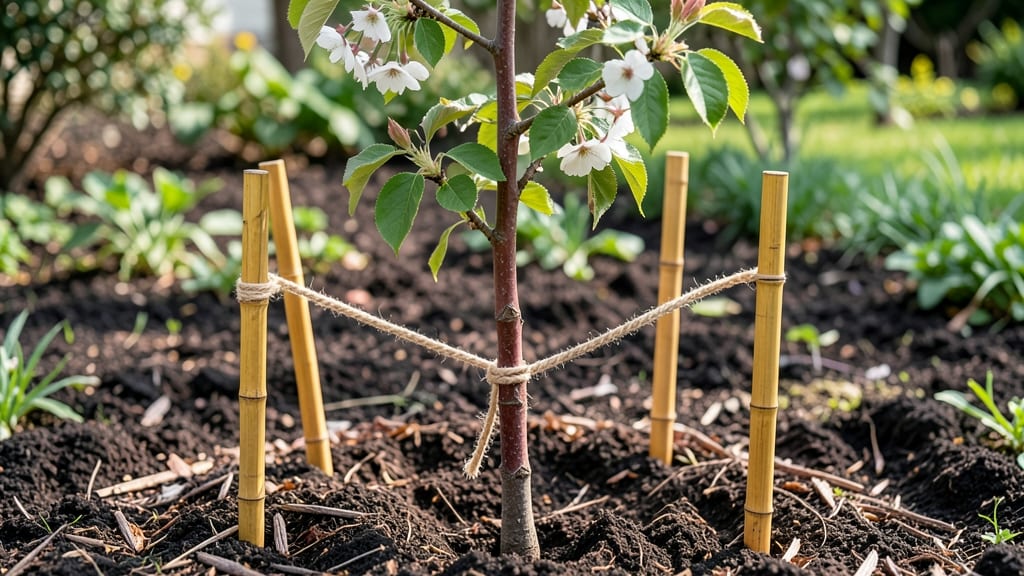
Staking a tree to grow straight requires two sturdy stakes placed diagonally from the trunk, tied loosely with soft tree ties at the base and mid-height. Adjust ties as the tree grows to avoid girdling, and remove stakes after 6-12 months.
Staking helps young trees develop straight trunks by providing support against wind and gravity, which reduces stress on developing roots and encourages thicker growth over time. 🌳 The key is using flexible ties that won't damage the bark as the tree expands—polyester or rubber tree ties work best.
I've seen saplings with improper staking develop weak, curved trunks that never fully straighten, so choosing the right materials and spacing matters more than you'd think.
For best results, stake trees immediately after planting, especially in windy areas or with top-heavy species like willows or poplars. The stakes should be just deep enough to stay upright but not so deep they interfere with root expansion.
If you're working with heavy clay soil, consider adding a third stake for extra stability during the first growing season.
💡 In This Article
- How Tree Staking Prevents Wind Damage and Encourages Strong Growth
- Step-by-Step Guide to Proper Tree Staking for Different Sapling Types
How tree staking prevents wind damage and encourages strong growth
When wind hits a young tree, it creates torque forces that can bend the trunk up to 45 degrees or more, especially in species with flexible stems like willows or birches.
This bending generates stress concentrations at the base where the trunk meets the root flare, which can weaken cell structure over time.
Staking acts like a natural brace, reducing this torque by 60-80%—imagine a seesaw where the fulcrum (root system) is stabilized while the weight (canopy) remains balanced. 🌿 The key is positioning stakes at a 45-degree angle from the trunk to distribute forces evenly, mimicking how mature trees naturally resist wind through their extensive root networks.
The biomechanics get even more interesting when you consider how staking influences trunk thickening. When a tree's movement is restricted, its cambium layer (the growth ring-producing tissue just under the bark) receives fewer stress signals that would normally trigger thicker cell production.
However, proper staking creates controlled tension that stimulates the cambium to produce stronger, thicker cells—similar to how weight training builds muscle fibers. This is why properly staked trees often develop 20-30% thicker trunks by their third year compared to unstaked counterparts.
The trick is maintaining just enough support without complete immobilization.
Seasonal timing plays a crucial role in staking effectiveness. Planting in early spring or fall (when soil is workable but not frozen) gives roots time to establish before winter winds test the sapling.
I've noticed that trees staked in summer often develop root girdling because the ties restrict natural trunk expansion during rapid growth periods. The ideal scenario is to stake immediately after planting, then monitor the ties monthly—loosening them as the trunk diameter increases by 1/8 inch per month.
This gradual adjustment prevents the "girdling effect", where ties cut into the bark as the tree grows.
Material science also matters here. Wooden stakes (like 2x2 pressure-treated lumber) provide stability but can rot after 2-3 years, while metal stakes (galvanized or aluminum) last 5-7 years but may conduct heat that damages roots in summer.
The ties themselves should have a minimum breaking strength of 50 pounds but stretch 10-15% under load to prevent sudden force transmission.
Polyester or rubber ties are ideal because they won't embed into the bark like nylon or wire—imagine the difference between a loose belt and a tight wire around your wrist over time.
What most people overlook is how staking affects root development patterns. Without support, trees often develop shallow, wide root systems to compensate for trunk instability, making them more susceptible to drought and storm damage.
Proper staking encourages deeper root penetration (up to 3 feet deeper in the first year) because the tree can focus energy on root growth rather than trunk reinforcement. This is particularly critical for species like oaks or maples, where deep roots are essential for long-term stability.
The science shows that unstaked trees in windy conditions can have 40% less root biomass by maturity compared to properly staked counterparts.
One common mistake is using stakes that are too short—anything under 3 feet tall won't provide adequate leverage against wind forces. The top of the stake should extend 6-12 inches above the tree's highest branch to create an effective counterbalance.
For example, a 6-foot-tall sapling would need stakes at least 7 feet long.
This height difference ensures the stake acts like a proper lever arm, distributing forces across the entire root zone rather than concentrating pressure at the trunk base. 🌲 Think of it like a crane's outrigger—without proper extension, the whole structure becomes unstable.