
Plants
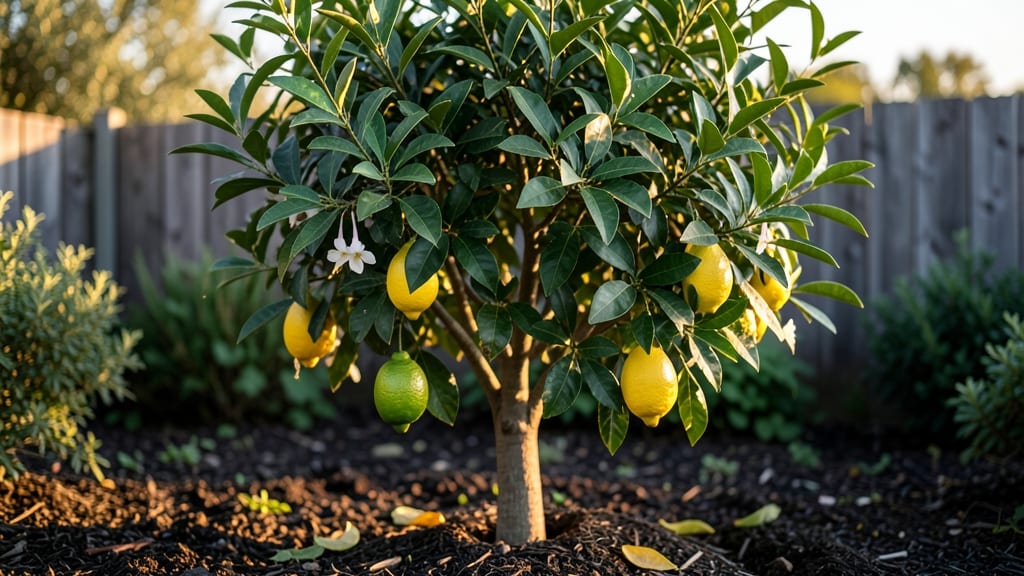
A lemon tree leaf looks like an oval-shaped, glossy green blade with finely toothed edges and a sharp point at the tip. Younger foliage appears lighter green, while mature leaves reach 2 to 4 inches in length, feeling thick and slightly waxy to the touch with a fresh citrus scent when rubbed.
A lemon tree leaf's distinct features make it easy to recognize once you know what to look for. 🌿 The elliptical shape and serrated edges set it apart from other citrus varieties—lime leaves are narrower and more pointed, while orange leaves are broader with smoother edges.
The leathery texture and bright green hue are also telltale signs, especially when you crush a leaf and get that unmistakable lemony aroma. This sensory clue alone can help differentiate it from lookalikes like bay laurel, which lacks the citrus scent entirely.
When identifying lemon tree leaves in your garden, pay attention to how they grow.
Lemon tree leaves typically cluster in groups of 3-5 along the stem, and the undersides often have a slightly paler green color. 💚 The scent becomes stronger as the leaves mature, making it a reliable way to confirm your identification.
If you're still unsure, compare them side by side with known citrus varieties—you'll quickly notice the subtle but consistent differences in shape, texture, and fragrance.
💡 In This Article
- Identifying Lemon Tree Leaves: Key Botanical Features
- How to Spot a Lemon Tree in Your Garden or Nursery
Identifying lemon tree leaves: key botanical features
The elliptical shape of a lemon tree leaf is its most defining characteristic, with dimensions typically ranging from 2 to 4 inches long and 1 to 2 inches wide. Botanically, these leaves are classified as "simple" (single blade) and "entire" (though the serrated edges create a "serrate" margin).
The leaf's midrib (central vein) runs straight from base to tip, with secondary veins branching out at 45-degree angles, creating a distinct lattice pattern. This vein structure helps distinguish lemon leaves from lime leaves, which often have more pronounced vein curvature.
The glossy, dark green coloration comes from a waxy cuticle layer that helps reduce water loss in the plant's native Mediterranean climate. Young leaves emerge with a lighter green hue and softer texture, gradually darkening and thickening as they mature.
This process, called sclerophyllization, gives mature leaves their leathery feel—similar to how a grapefruit's skin becomes tougher over time. 🌿 The serrated margins (tiny saw-like teeth) are another key feature, with each tooth measuring about 0.1 to 0.2 inches long, spaced roughly 0.25 inches apart.
One of the most reliable identification markers is the aromatic profile when leaves are crushed. Lemon tree leaves contain limonene and citral compounds, which create that signature citrus scent. This fragrance comes from volatile oils stored in specialized cells called oleoresin canals within the leaf structure.
Unlike bay laurel leaves (which smell like cloves when crushed) or orange leaves (which have a milder, almost floral scent), lemon leaves release a bright, zesty aroma that's immediately recognizable—even to those who aren't citrus connoisseurs.
The leaf arrangement is another critical detail: lemon tree leaves grow in alternate spirals along the stem, with 3 to 5 leaves clustering at each node.
This differs from lime trees, where leaves often grow in pairs or single stems, and orange trees, which may have broader, more rounded leaves with smoother edges.
The petiole (leaf stalk) is typically 0.5 to 1 inch long, slightly swollen at the base—a feature that helps anchor the leaf securely to the stem.
Seasonal changes also play a role in leaf appearance. In cooler months, lemon tree leaves may develop a slightly bluish tint due to reduced chlorophyll production, while in full sun, they maintain their vibrant green.
The leaf apex (tip) is always acute (sharp-pointed), never rounded like some citrus hybrids. This pointed tip helps prevent water accumulation, reducing fungal risks—a clever evolutionary adaptation for the plant's humid growing conditions.
For a hands-on comparison, try this test: Hold a lemon leaf up to a lime leaf side by side. Notice how the lemon's edges have more frequent, finer teeth, while lime leaves often appear narrower with coarser serrations.
Run your thumb along both—lemon leaves feel smoother and slightly waxier, whereas lime leaves may have a rougher texture. The scent test is foolproof: crush a small piece of each leaf between your fingers.
Lemon leaves will fill the air with that bright, almost electric citrus fragrance, while lime leaves offer a more subtle, herbal note.