
Plants
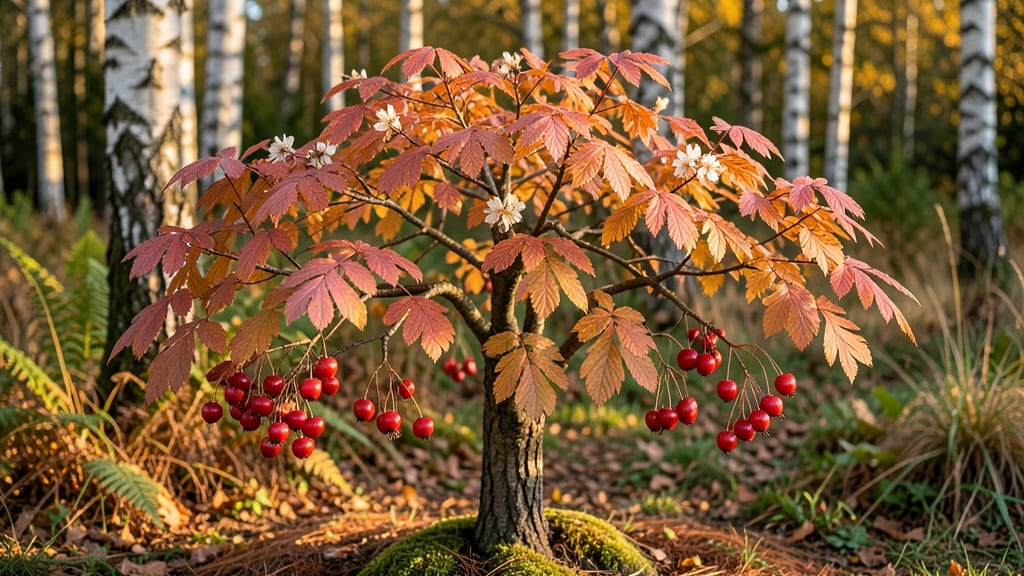
A rowan tree looks like a small to medium deciduous tree with a rounded, spreading crown and distinctive features: its bark is smooth and grayish-brown, turning furrowed with age, while its leaves are oval, serrated-edged, and bright green in summer. In autumn, the leaves turn vibrant yellow or orange, and its clusters of bright red berries appear in late summer, persisting into winter.
A rowan tree stands out with its elegant, almost fairy-tale appearance. 🌳 The oval leaves with jagged edges create a lacy effect, especially when backlit by sunlight, while the bright red berries in winter act like nature's holiday ornaments.
Unlike its close relative, the mountain ash, rowan berries stay clustered tightly on the branches, and the tree's overall shape is more compact—reaching about 15 to 25 feet tall at maturity.
What's fascinating is how the bark evolves: starting smooth and silvery, it develops deep grooves as the tree ages, adding to its character.
This tree thrives in cool climates, often found in woodlands and along stream banks, where it becomes a focal point in winter landscapes. The berries, while toxic to humans, are a vital food source for birds, helping spread the tree's seeds.
I've noticed that rowans often grow in clusters, creating a striking visual impact when their autumn foliage shifts from green to fiery hues.
💡 In This Article
- Identifying Rowan Tree Bark, Leaves, and Growth Habits
- Rowan Tree Berries: Color, Seasonality, and Wildlife Attraction
Identifying rowan tree bark, leaves, and growth habits
The rowan tree's bark is one of its most striking features, especially as it matures. Young specimens showcase smooth, silvery-gray bark that resembles polished stone, often developing a slightly waxy texture that reflects light.
As the tree ages—typically after 10-15 years—this bark transforms into deep, vertical fissures that create a rugged, almost sculptural appearance.
These grooves can become quite pronounced, especially on the lower trunk where moisture accumulates, giving the bark a weathered, almost ancient look. 🌲 The color darkens to a muted brown with age, creating a beautiful contrast with the vibrant foliage.
Rowan leaves are another key identification feature, measuring about 2-4 inches long with a distinctive oval shape and finely serrated edges that create a delicate, almost feathery outline.
What sets them apart is their arrangement: the leaves grow alternately along the branches, unlike some similar trees where they appear in clusters.
In summer, they're a glossy, bright green that catches sunlight beautifully, but their real magic happens in autumn when they shift to fiery hues of yellow, orange, or even deep red.
This color change occurs due to the breakdown of chlorophyll and the unmasking of carotenoids and anthocyanins in the leaves.
The tree's growth habit is equally distinctive. Rowan trees typically grow to a mature height of 15-25 feet with a rounded, spreading crown that creates a natural umbrella shape.
The branches often grow at wide angles, sometimes even horizontally, which helps distinguish it from mountain ash (which has more upright branches) or hawthorn (which has sharper, more thorny branches). What's fascinating is how rowan trees often grow in multi-stemmed clusters, creating dense thickets that provide excellent wildlife habitat.
The overall structure is more compact than its mountain ash relative, making it perfect for smaller gardens or woodland edges.
One of the most helpful identification tricks is to look at the leaf buds in late winter. Rowan buds are small, oval, and pointed, with a distinctive reddish-brown color that stands out against the bare branches.
These buds typically appear in clusters of 2-3 along the branch, another feature that helps distinguish rowan from similar trees. The combination of these visual cues—bark texture, leaf arrangement, and bud shape—makes rowan trees relatively easy to identify once you know what to look for. 🔍
Seasonal variations play a crucial role in identification. In spring, you'll notice new growth emerging from the reddish buds, followed by fresh green leaves that develop their characteristic serrated edges. Summer brings the full foliage display, while autumn transforms the tree into a fiery spectacle.
Even in winter, rowan trees remain visually striking with their persistent red berries and distinctive bark pattern, making them one of the most recognizable trees in the landscape throughout the year.
For those trying to distinguish rowan from similar trees like mountain ash or hawthorn, pay attention to these key differences: rowan berries stay clustered tightly on the branches (unlike mountain ash's more open clusters), and the leaves lack the strong scent that hawthorn leaves often emit when crushed.
The overall growth habit—more compact and rounded—is another reliable indicator. These visual clues make rowan trees both beautiful and relatively easy to identify in the wild. 🌿